

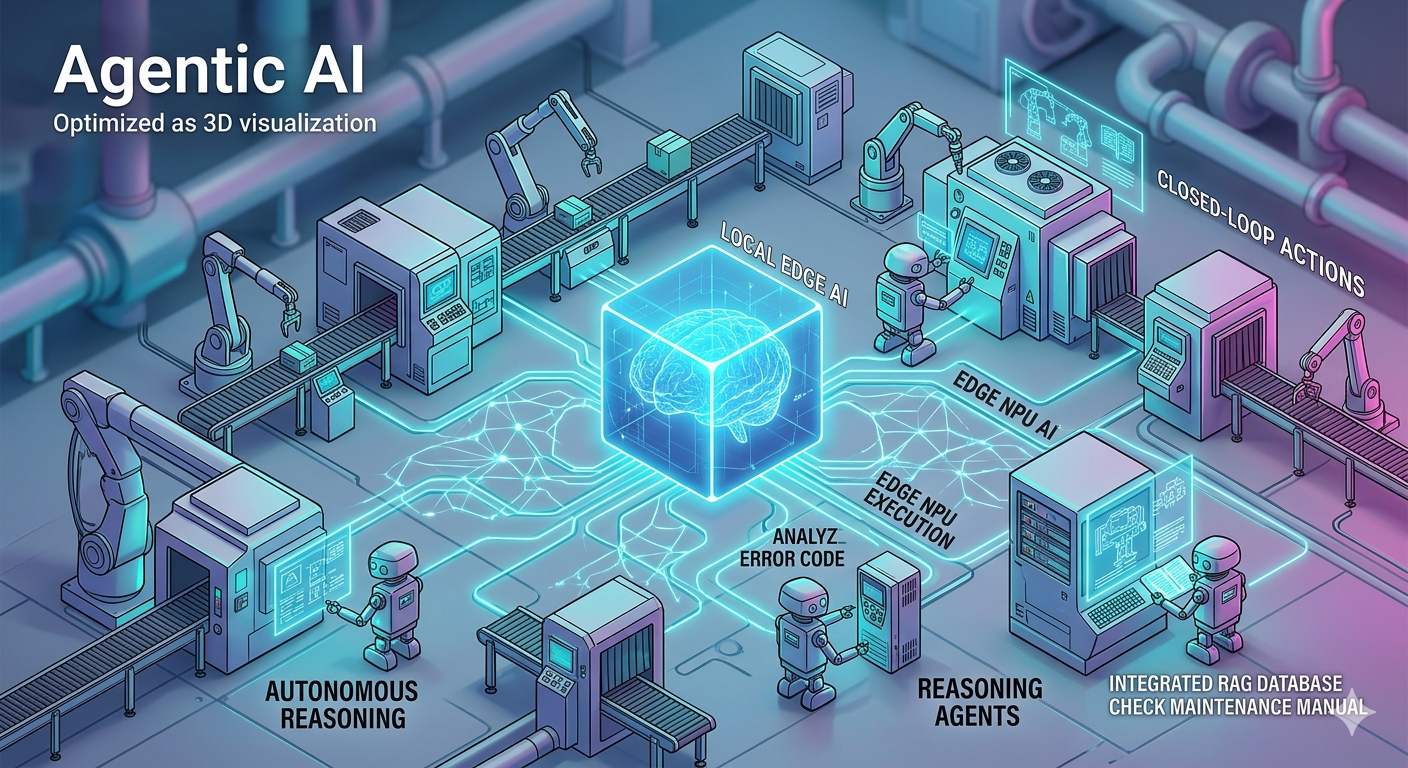
The Rise of Agentic AI: Moving from "Predictive" to "Autonomous" Industrial IoT in 2026
Introduction: Beyond the Static Dashboard
For the past decade, the Industrial Internet of Things (IIoT) promised a revolution through "Big Data." However, for many facility managers, this resulted in "Data Fatigue"—dashboards filled with red lines that still required a human expert to diagnose and fix.
As we move through 2026, the paradigm has shifted. We are entering the era of Agentic AI at the Edge. This isn't just a chatbot; it is a system that perceives a fault, reasons through the technical manual, and executes a recovery plan autonomously.
What is Agentic AI in an Embedded Context?
Traditional Edge AI is reactive. It uses simple pattern recognition to flag an anomaly (e.g., "Motor vibration has exceeded 5mm/s").
Agentic AI is proactive. By utilizing Small Language Models (SLMs)—quantized versions of models like Phi-4-Mini or Llama-3-Edge—the system can perform "Chain-of-Thought" reasoning. When an anomaly is detected, the agent doesn't just send an alert; it initiates a ReAct (Reason + Act) loop:
- Observation: Motor #4 temperature is rising 2°C per minute.
- Reasoning: Cross-referencing current RPM with the lubrication schedule stored in the local RAG (Retrieval-Augmented Generation) database.
- Action: Throttling the VFD (Variable Frequency Drive) to 70% and placing an order for a technician via the ERP API.
The Technical Pillars of 2026 Edge Intelligence
1. On-Device SLMs and NPU Acceleration
In 2026, we no longer send raw industrial data to the cloud for inference. Privacy and latency requirements demand local execution. Modern microcontrollers (like the high-performance ESP32-P4 or nRF54 series) now feature dedicated Neural Processing Units (NPUs). These allow 4-bit quantized SLMs to run locally, ensuring that critical decision-making stays within the factory firewall.
2. The Model Context Protocol (MCP)
One of the biggest hurdles in industrial automation has always been fragmentation. How does an AI talk to a 20-year-old PLC? The Model Context Protocol (MCP) acts as a universal "translator." It allows the AI agent to query Modbus registers, CAN bus frames, and MQTT topics through a standardized interface, removing the need for custom-coded drivers for every specific sensor.
3. Local RAG (Retrieval-Augmented Generation)
Agentic AI is only as smart as the data it can access. By storing technical manuals, circuit diagrams, and historical maintenance logs in a local Vector Database at the edge, the AI can "read" the manual in real-time to troubleshoot a specific fault code without human intervention.
Why This Matters for Your Bottom Line
The transition to Agentic AI isn't just a technical flex; it solves the "Expert Gap." With a global shortage of specialized maintenance engineers, having a system that can "self-triage" reduces Mean Time to Repair (MTTR) by up to 60%.
- Zero Latency: Decisions are made in milliseconds, not seconds.
- Architectural Sovereignty: Your data never leaves the premises.
- Operational Continuity: The machine explains why it is failing and how to fix it, reducing guesswork for junior technicians.
Conclusion: The Future is Autonomous
At JESilix Solutions, we specialize in bridging the gap between legacy industrial hardware and the next generation of Agentic intelligence. Whether you are looking to upgrade an existing production line or design a Matter-native gateway from scratch, the goal is the same: Intelligence where it matters most—at the edge.
SEO Optimization Breakdown
- Primary Keyword: Agentic AI Industrial Edge
- Secondary Keywords: SLM for Embedded Systems, ReAct Framework IoT, Model Context Protocol 2026, Local RAG Industrial.
- Meta Description: Discover how Agentic AI and Small Language Models (SLMs) are revolutionizing industrial automation in 2026 by moving decision-making to the edge.