

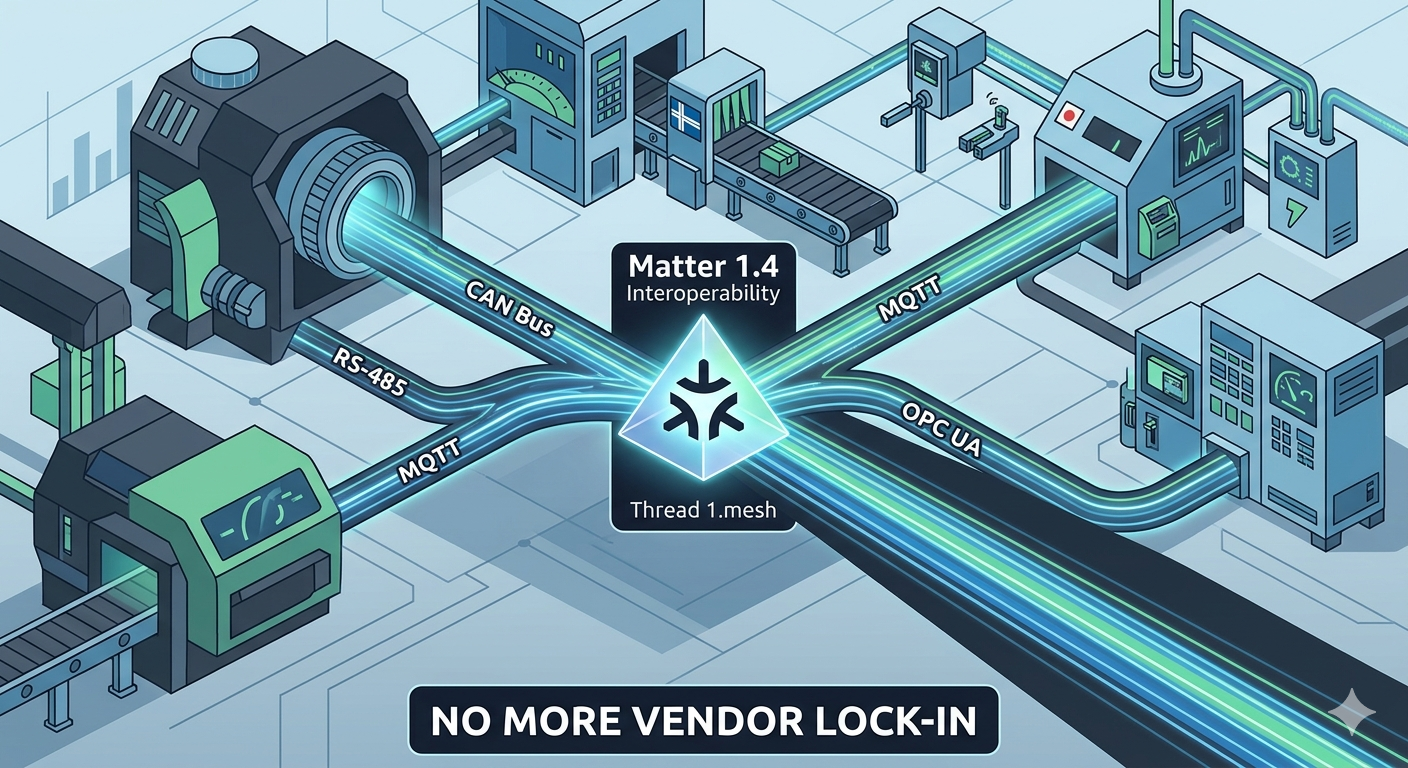
Matter 1.4 & Thread 1.4: The End of Industrial Network Fragmentation in 2026
Introduction: Why Interoperability Finally Won
Until recently, the industrial world was a "walled garden" of proprietary protocols. If you chose a specific brand of sensors, you were often locked into their gateways, their software, and their supply chain. In 2026, that era is officially over.
The widespread adoption of Matter 1.4 and Thread 1.4 has created a unified language for the industrial edge, ensuring that devices from different manufacturers don't just "coexist"—they collaborate.
Thread 1.4: The Backbone of the Industrial Mesh
While Matter provides the "what" (the application layer), Thread 1.4 provides the "how" (the networking layer). In 2026, Thread has solved the two biggest complaints of early adopters: credential sharing and network partitions.
1. Standardized Credential Sharing
In earlier versions, adding a new device often meant creating a separate "Thread Island" for every vendor. Thread 1.4 introduces standardized credential sharing, allowing any Thread Border Router—regardless of the brand—to extend a single, robust mesh network across your entire facility.
2. Thread Over Infrastructure
Thread 1.4 allows your existing Wi-Fi 7 access points and Ethernet backbones to act as native extensions of the Thread mesh. This "Thread Over Infrastructure" capability means your network can bridge massive physical distances without needing a daisy-chain of battery-powered repeaters.
Matter 1.4: Long Idle Time (LIT) and Energy Efficiency
The most significant update for 2026 industrial sensing is the Long Idle Time (LIT) protocol.
Previously, battery-powered sensors (like vibration or humidity monitors) had to "wake up" every few seconds to stay connected to the network, draining batteries in months. With LIT, these "Intermittently Connected Devices" (ICDs) can stay in a deep sleep for much longer periods while remaining reachable.
- The Result: 2026 sensors are achieving 5–7 years of battery life on a single coin cell, making them finally viable for large-scale industrial deployment where maintenance access is difficult.
Enhanced Security with Network Infrastructure Managers (NIMs)
Security in 2026 isn't just about encryption; it's about visibility. Matter 1.4 introduces the Network Infrastructure Manager (NIM) role.
- Role of NIMs: These are routers or access points that provide the "source of truth" for the network. They manage Access Restriction Lists (ARLs) and Certificate Revocation Lists (CRLs), ensuring that if a device is compromised, it is instantly quarantined from the rest of the factory floor.
Why This Matters for Your 2026 Roadmap
Standardizing on Matter and Thread 1.4 isn't just about following a trend; it's about future-proofing your CAPEX.
- Vendor Agnostic: Buy the best sensor for the job, not the one that matches your hub.
- Scalability: Thread’s self-healing mesh grows stronger as you add more devices.
- Reduced Infrastructure: Your existing Wi-Fi APs become your IoT gateways, reducing hardware costs by up to 30%.
Conclusion: Seamless Integration with JESilix Solutions
At JESilix Solutions, we don't just build gateways; we build bridges. Our 2026 product lineup is fully Matter 1.4 certified, ensuring that your industrial automation transition is as simple as "plug, pair, and perform."
SEO Optimization Breakdown
- Primary Keyword: Matter 1.4 Industrial
- Secondary Keywords: Thread 1.4 Specification, Long Idle Time (LIT) IoT, Industrial Mesh Networking, Interoperability 2026, Thread Border Router Credential Sharing.
- Meta Description: Explore how Matter 1.4 and Thread 1.4 are revolutionizing industrial IoT in 2026 with improved battery life, unified mesh networks, and enhanced security.